
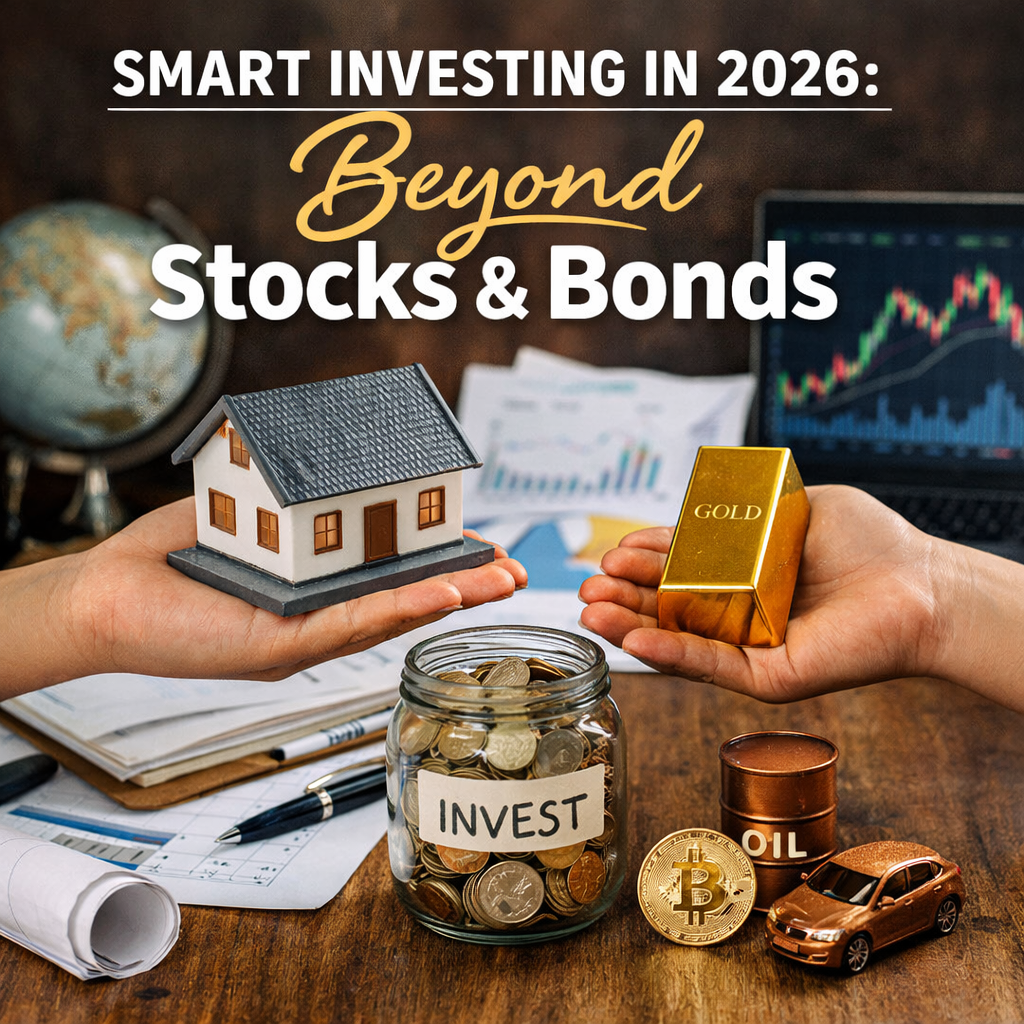
2026 has proven to be a year of volatility — markets, politics, and global conflicts are constantly shifting. In such an environment, investing must evolve with the times. Here are opportunities beyond traditional stocks and bonds that deserve attention.
Table of Contents
What Does “Beyond Stocks and Bonds” Mean?
Traditionally, investing knew just these two terms – “stocks” and “bonds” where,
- Stocks → Ownership in companies
- Bonds → Lending money to governments or companies
For decades, the classic strategy was: 60% Stocks + 40% Bonds. This worked because: Stocks gave growth and Bonds gave stability. But in 2026, investors are questioning this model because:
- Markets are volatile.
- Interest rates move unpredictably.
- Global risks (wars, inflation, AI disruption) are rising.
So, investors are exploring other asset classes and that’s what “Beyond Stocks and Bonds” means. Let’s look at them closely.
THREE MAIN ALTERNATIVES
Real Estate Tech (PropTech)
Traditionally, to invest in real estate, you needed ₹50 lakhs – ₹1 crore to buy property. But now, you can invest small amounts through REITs. You can buy fractional ownership and some platforms even tokenize real estate.
For Example: Embassy Office Parks REIT
This allows investors to invest in commercial properties without buying full buildings. The reason why people like it:
- It gives Rental income.
- Inflation protection.
- Lower entry barrier.
But the possible risks involved are:
- Property market cycles.
- Liquidity issues.
- Regulatory risks.
Commodities
Commodities = Physical raw materials like, Gold, Silver, Oil, Copper, Agricultural goods. For Example: Gold ETFs
The reason why commodities are trending:
- Inflation hedge.
- Geopolitical tensions affect supply.
- Energy transition increases demand for metals like lithium.
But the possible risk involved is that:
- Prices are volatile.
- No regular income like dividends.
Alternative Assets
This is a broad category. It includes: Private equity, Infrastructure funds, Hedge funds, Crypto, Art, collectibles
For Example: Bitcoin
Why people invest in alternative assets:
- High return potential.
- Low correlation with stock market.
- Portfolio diversification.
Risks:
- High volatility.
- Less regulation.
- Sometimes low liquidity.
Why Is This Relevant in 2026?
Investment options other than the traditional “Stocks and Bonds” are not new. Most of these alternative options existed since more than 60 years but the reason they are relevant most in 2026 is because:
- Stock markets are heavily influenced by AI hype.
- Bond returns depend on central bank policies.
- Inflation still worries investors.
- Young investors want diversification.
So, the big question is:
Should investors rely only on stocks and bonds, or diversify into alternative assets?
What “Smart Investing” Actually Means
Smart investing in 2026 doesn’t mean:
- Chasing crypto trends.
- Buying random commodities.
- Following influencers.
It means:
- Understanding risk.
- Diversifying properly.
- Allocating assets according to goals.
- Studying macroeconomic conditions.
MY POV
According to my POV, diversification is really important for an investor because it gives a sense of security in psychological way. And it even supports that saying “ if you have 1000 keep 500 in one pocket and 500 in the other so that if someone picked up your one pocket you at least have those 500”. But as we know the world is a volatile and wild space to be so no wonder what might happen next. Investing smartly is much needed in this ai boom era