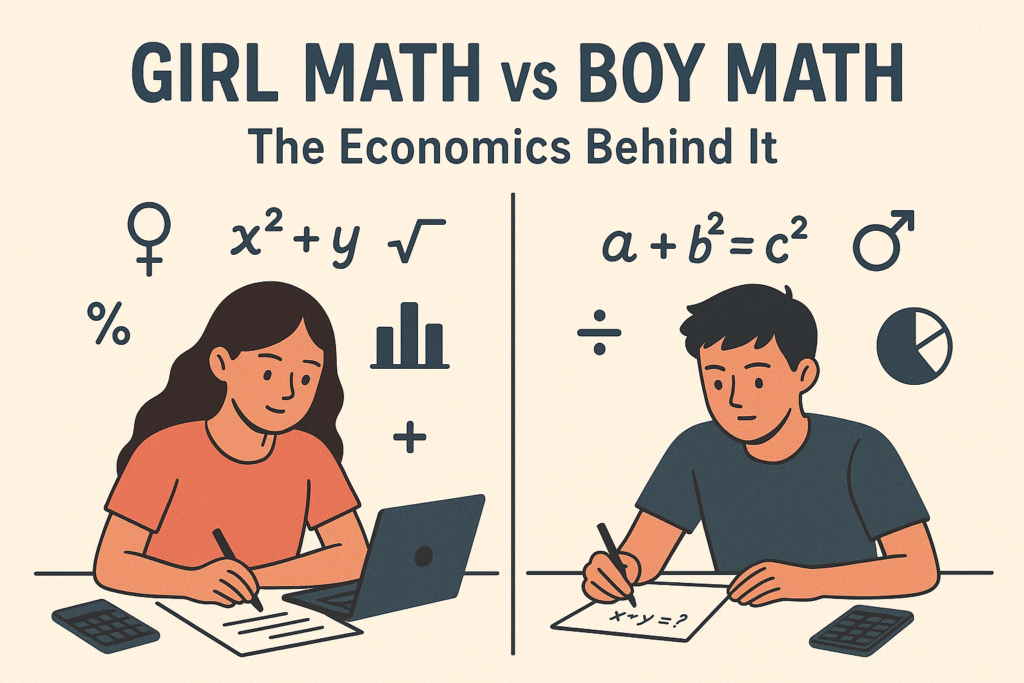
If you’ve spent even 10 minutes on TikTok or Instagram, you’ve definitely seen it – Girl Math. Boy Math.
Two trends roasting the funny ways we justify money decisions.
But, turns out… it’s not just a meme or merely related to gender.
It’s Behavioural Economics. Go down and see how?
Table of Contents
Girl Math: The Art of Justifying Spending
Girl math isn’t about being bad with money – it’s about making spending emotionally easier and feel less guilty.
Cash, UPI, refunds are treated differently. Using UPI has basically influenced girls in thinking that,
“If I am paying in cash, it is basically free.”
“If I return something, I made money.”
“If it’s under ₹500, I didn’t actually spend.”
“If I wear the dress 10 times, cost per wear drops, so it’s a good investment.”
All these philosophies sound psychological but there’s real economics behind that you need to fight to correct your money behaviour –
Mental Accounting: it is the behavioural bias where people categorize money into separate mental “accounts” based on its source or intended use, rather than treating all money as equally valuable and interchangeable.
Loss Aversion: it is the tendency to prefer avoiding losses over acquiring gains because people feel the pain of a loss more intensely than the pleasure of an equivalent gain. So, it creates cute justifications.
Sunk Cost Fallacy: it is the phenomenon whereby a person is reluctant to abandon a strategy or course of action because they have invested heavily in it, even when it is clear that abandonment would be more beneficial. It is like “I already bought it, so I must use it.”
Boy Math: Confidence + Calculations + Chaos
Boy math is basically…. risk-taking with full confidence which is maybe* overconfidence as well.
If you are an active user of social media, following things might sound relevant to you –
“Buying a ₹1,20,000 iPhone is an investment.”
“Crypto will 10x, trust me bro.”
“If I speed, I reach faster, so I save time. Time is money.”
“₹2000 on petrol but ₹50 delivery charge? No way.”
But this is not merely overconfidence it does have real economic logic –
Overconfidence Bias: it is a cognitive bias where a person’s subjective confidence in their judgments is reliably greater than the objective accuracy of those judgments, basically believing your decisions are always right.
Optimism Bias: it is a common cognitive bias where people tend to overestimate the likelihood of positive events in their future and underestimate the likelihood of negative events, basically assuming the future will favour you.
Risk Appetite: it is the amount and type of risk an organization or individual is willing to accept to achieve its objectives because men statistically take higher financial risk.
MY POV
It’s not really about girls vs boys – it’s about how humans emotionally deal with money. These habits feel more common today because social media and herd culture make them more visible. We don’t always make logical choices; we make emotional ones and justify them later in funny ways. And that doesn’t make anyone silly – it’s simply how the human mind works.
📌Author’s Note:
This blog is not just research — it’s a step in my journey toward working with global institutions like the IMF and World Bank.
Stay tuned and grow with me