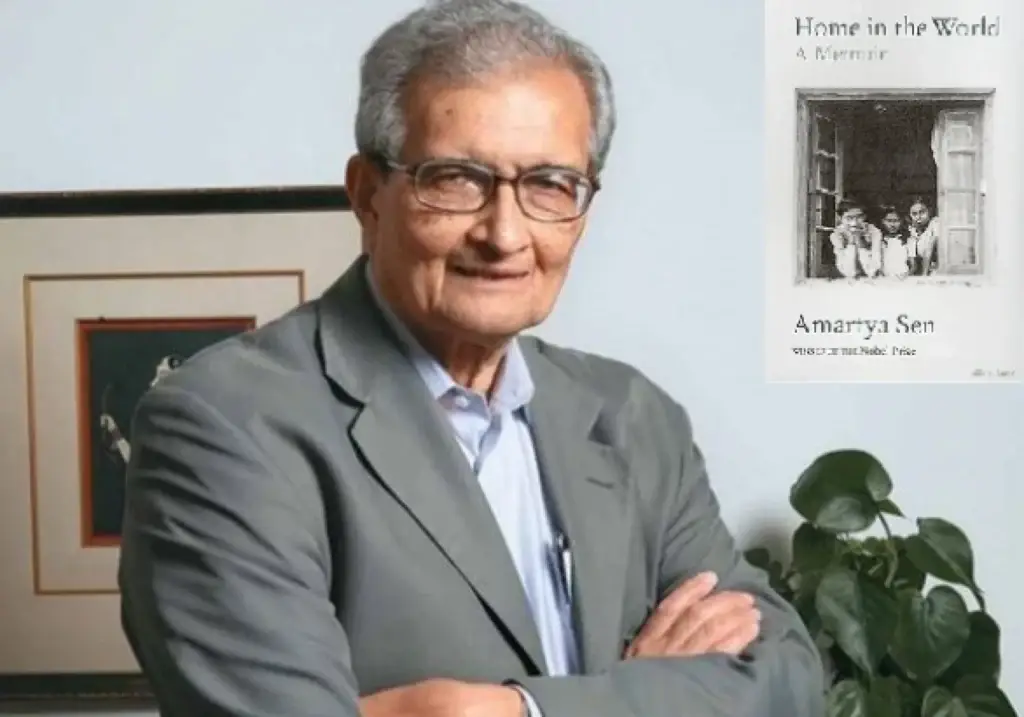
Imagine a man, shaped by the realities of his homeland, developing outstanding theories from his personal experiences — understanding cause and effect, centering his ideas around human welfare — and rising to heights few have reached. Amartya Sen, who studied at Trinity College, Cambridge and became the first Asian to head an Oxbridge college (the same where studied), alongside leading several prestigious universities across India and England.
Let’s explore about his lifestyle, academics, theories, criticism and many more:
Table of Contents
WHO WAS AMARTYA SEN?
Amartya Sen is one of the most important economist and philosopher of our time. From receiving 1998 Noble Prize to becoming a Master of Oxbridge University- his life is filled with such milestones. Born in 1933 in Santiniketan, West Bengal, India, educated from Presidency College, Calcutta (now in Kolkata). Later on went to Trinity College, Cambridge where he received a B.A., an M.A., and a Ph.D.
One of the most highlighting and notable part of his life is his contribution to the welfare economics and development through the “capability approach” that is discussed below.
EVENTS INFLUENCING SEN’S IDEAS
Behind Sen’s outstanding theories and ideas there are certain events in his life that made him think the way he thought and brought up his ideas which are as follows:
- PARTITION OF INDIA
Sen witnessed the partition of India and creation of Pakistan, he saw communal violence and mass displacement, which influenced his interests in issues like identity, tolerance, and justice.
Impact: Strengthened his commitment to plurality, democracy, and human rights.
- EDUCATION IN INDIA AND UK
Early education: Presidency college, Calcutta – grounded him with classical economics and philosophy.
Further studies: Trinity college, Cambridge— here he interacted with major philosophers and economists, like Piero Sraffa, John Hicks, and Maurice Dobb, which shaped his rigorous approach to welfare economics.
- EXPOSURE TO GLOBAL INEQUALITIES
As Sen worked and taught in India, UK, and the US, he gained insights into different models of development and inequality, especially contrasting the poverty in India with the affluent but unequal West.
- DEBATES ON DEVELOPMENT ECONOMICS
In the 1970s and 1980s, he was critical of development models that focused only on GDP growth. Instead, he advocated for a “capability approach” — focusing on what people are actually able to do and be.
Major Work: Development as Freedom (1999) — argued that freedom is both the means and the end of development.
- GLOBAL GENDER INEQUALITIES
Sen was influenced by the inequalities faced by women in India and elsewhere, Sen wrote extensively on gender inequalities, missing women and lack of female education and healthcare.
- INTERACTIONS WITH OTHER THINKERS
Interactions with philosophers like John Rawls also influenced his work on justice culminating in his book “The idea of justice” (2009), which critiqued the ideal theories and focused on practical justice.
Above listed are the events of Sen’s life that influenced him now let’s see the theories given by him with the above influence.
REMARKABLE FEATS
Amartya Sen is an Indian economist and philosopher, he significantly contributed in welfare economics, development economics, social choice theory, and political philosophy. His theories focus on justice, human welfare, and development. Following are the most important theories:
1. CAPABILITY APPROACH
Main idea: Development should focus on enhancing people’s capabilities -what they are able to do or be, rather than just economic growth or income. This means that two people may have the same income but one may be sick and unable to work. The capability approach values the freedom to live a life one values, beyond income.
2. SOCIAL CHOICE THEORY
Amartya Sen build upon and extends the work of Kenneth Arrow. This deals with aggregating individual preferences into collective decisions. Sen showed how social welfare can be improved by considering justice, rights, and freedoms, not just efficiency. He introduced the concept of “Impossibility of a Paretian Liberal”, showing conflicts between collective rationality and individual rights.
3. DEVELOPMENT AS FREEDOM
Sen believed that development is the process of expanding real freedom that people enjoy.
Types of freedom highlighted:
>Political freedom
>Economic facilities
>Social opportunities
>Transparency guarantees
>Protective security
Main idea of Sen was that poverty is not just low income but the deprivation of basic freedoms for example- lack of education, healthcare, participation etc.
4. THEORY OF FAMINES
Main idea: famines occur not just due to lack of food but because of failure of access(entitlement).
Sen’s most famous study of famines especially the Bengal Famines 1943. Introduced the concept of “Entitlement Approach” — people starve when they lose the ability to acquire food, even if food is available in the market.
5. JUSTICE AND THE IDEA OF “NITI” & “NYAYA”
In his book “The Idea of Justice” Sen distinguishes between
>NITI – rules, institutions, process (ideal justice theories).
>NYAYA – realized justice in the actual world.
Sen has extensively focused on comparative justice i.e. improving justice rather than seeking a perfect just society.
The theories of Amartya Sen provide an angle for the world in determining justice and identifying people’s true capability.
SEN’S CONTRIBUTION TO HDI
Amartya Sen, a Nobel laureate economist marked his contribution to the creation of “Human Development Index” by providing the framework for its measurements along with the economist Mahbub ul haq.
HDI measures a country’s development not just by GDP but also includes – life expectancy, education level, per capita income etc. here Sen’s work on “capabilities” and “functioning” laid the foundation for HDI.
The HDI, developed by the United Nations Development Programme (UNDP), incorporates Sen’s ideas by measuring a country’s progress in health, education, and living standards, reflecting his emphasis on human well-being.
Hence, Sen’s work influenced the UNDP’s approach to development, which is reflected in the Human Development Reports and the HDI itself.
CRITICISM FACED BY AMARTYA SEN
While Sen was highly respected, his theories did faced criticism by various economists, philosophers and policymakers. Here’s a breakdown of main criticism faced by him:
Criticism of Capabilities Approach
Vague list: critics like Martha Nussbaum argued that Sen has never provided a clear, universal list of capabilities making the approach too open-ended and difficult for policymakers to adopt.
Measurement issues: critics also argued that capabilities are hard to identify, compare, and quantify for different countries and cultures whereas the measurement of income or GDP is comparatively easy.
Subjective approach: Some of the critics argued that the approach is too subjective that it ignores the factors like different cultures, regions, and people making the approach hard to adapt.
Criticism of Entitlement Approach
Ignores food supply: critics argue that Sen’s theory overlooked the supply side factors and downplayed food production factors.
Limited application: some critics argue that his theory works best with market economies but lacks at explaining famines in war zone areas or collapsed states where there are no functioning markets or governance.
CRITICISM OF DEVELOPMENT AS FREEDOM
Idealism vs Practicality: Critics argue Sen’s idea is too idealistic and normative, lacking concrete strategies for achieving those freedoms.
Policy-makers often find it hard to translate freedom-based approaches into actionable economic plans.
Neglect of Economic Growth’s Centrality: Some economists (especially from neoliberal schools) argue that Sen downplays the role of rapid economic growth and industrialization, which historically lifted millions out of poverty (e.g., China).
CRITICISM FROM LIBERTARIAN AND COMMUNITARIAN THINKERS
From Libertarians: Argue that Sen’s focus on redistribution and state involvement in ensuring capabilities can undermine individual liberty and free market efficiency.
From Communitarians: They criticize Sen for over-emphasizing individuals, ignoring community-based values, traditions, and responsibilities in some cultures.
CRITICISM IN SOCIAL CHOICE THEORY
Complexity and Abstract Nature: His work on social choice theory is seen as highly mathematical and abstract, with limited direct application in real-world policy debates.
CONCLUSION
Amartya Sen’s work has profoundly reshaped the way we understand development, justice, and human well-being. By shifting the focus from mere economic growth to real freedoms and capabilities, he challenged traditional development models and inspired more humane and inclusive approaches. While his theories are not without criticism, their impact on global policy—from the Human Development Index to poverty measurement—remains undeniable. Sen’s ideas continue to guide economists, policymakers, and thinkers toward building a more just and equitable world, where development is not just about wealth, but about expanding the real freedoms people have to lead meaningful lives.
MY POV
Amartya Sen was—and continues to be—one of the most influential economists and philosophers of our time. He focused extensively on justice, development, individual capabilities, famines, and social choice theory. Having travelled widely and taught at some of the world’s most prestigious universities, Sen gained international exposure that deeply influenced his thinking. This exposure enabled him to observe and compare economic and social disparities across different regions of the world—not just within India.
Sen strongly advocated for both ideal and practical justice, as well as the actual development of people through freedom. His introduction of the “Entitlement Approach” provided a new perspective on the causes of famine, arguing that people starve not because of a lack of food, but due to a failure in access and distribution.
In my view, Sen was not only an exceptional economist but also a remarkable intellectual. Having personally witnessed the Bengal Famine and the Partition of India, he was exposed to a wide range of economic environments—from poverty in India to the capitalism of the UK and USA. This allowed him to understand both ends of the economic spectrum—socialist and capitalist, poor and rich—which shaped his focus on welfare economics.
I believe that his strong emphasis on human welfare and fair justice stems from these real-life experiences. His work is rooted in deep empathy and a desire to improve the human condition.
Of course, his theories faced criticism from different economists and philosophers. While his capability approach has significantly influenced the Human Development Index (HDI), it falls short in explaining the extent of measurement and practical implementation. Similarly, his advocacy for government intervention in ensuring welfare was questioned. But in my view, this criticism is not entirely justified—because welfare economics, by nature, cannot rely solely on individual decisions. In matters of justice and equity, structured and fair state intervention is often necessary.
Hence, I believe that Amartya Sen’s ideas continue to be relevant and powerful in guiding societies toward inclusive, just, and human development. However, some of his theories can be challenging for policymakers to adapt and implement, as they may appear impractical in certain real-world contexts.
SOURCES
INVESTOPEDIA, WIKIPEDIA, BRITANNICA, INERTANTIONAL MONETARY FUND, STANFORD ENCYCLOPEDIA OF PHILOSOPHY, THE HISTORY OF ECONOMICS THOUGHT WEBSITE, THE LIBRARY OF ECONOMICS AND LIBERTY, BBC, PAKISTAN INSTITUTE OF DEVELOPMENT ECONOMICS, UNDP, CORPORATE FINANCE INSTITUTE.
📌Author’s Note:
This blog is not just research — it’s a step in my journey toward working with global institutions like the IMF and World Bank.
Stay tuned and grow with me!