Imagine an economy with free trade, competition, and letting businesses work without too much of government control. It is like people working for their own benefits which directly proves to be beneficial for economy as well.
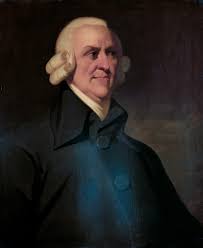
Adam smith, known as the father of economics advocated for capitalist economy and described how human behaviour works for the economy.
Table of Contents
WHO WAS ADAM SMITH?
Adam Smith was a Scottish economist, philosopher and author. He is known as the father of modern economics.
Smith argued against mercantilism as he was a major proponent of laissez-faire economy. In his first book, “The Theory of Moral Sentiments“, Smith proposed the idea of invisible hand—the tendency of free markets to regulate themselves using competition, supply and demand, and self-interest.
His book “THE WEALTH OF NATIONS” brought him most of his fame. Smith’s ideas—the importance of free markets, assembly-line production methods, and gross domestic product (GDP)—formed the basis for theories of classical economics.
EVENTS INFLUENCING SMITH’S IDEAS
Following listed are some of the events that influenced Adam Smith to think the way he interprets economy:
- The Scottish Enlightenment
Smith lived during the time when thinkers in Scotland were exploring reason, science, economy, human nature etc. This intellectual environment made him think deeply about society and economy.
- Industrial and Commercial growth
Britain was growing richer through trade, colonization, and early industrialization. Smith observed how commerce and industry were creating wealth, which influenced his ideas about free markets and economic growth.
- Mercantilism criticism
The dominant economic theory then (mercantilism) focused on accumulating gold and government-controlled trade. Smith criticized it and argued that free trade and competition were better for national wealth.
- Influence of other thinkers
Smith was inspired by philosophers like David Hume (his close friend) and Francis Hutcheson (his teacher), who talked about human nature, morality, and economics.
- Global exploration and Colonization
The expansion of trade routes and discovery of new markets showed Smith the importance of international trade, leading to his support for free trade between nations
REMARKABLE FEATS
Adam Smith theories play a major role in the ideology of classical economics. Following listed are the theories given by Adam Smith:
1. THE THEORY OF ABSOLUTE ADVANTAGE
This theory belongs to “The Wealth of Nations 1776”- a book written by Adam Smith. Here Smith suggests that a country should produce goods it can make more efficiently than others, and trade the rest to gain profit through trade.
In other words, absolute advantage is the ability of an individual, country or a region to produce more of a good at the same or lesser amount of input.
For example: if India is good at textiles and Japan is good at electronics, both should specialize and trade.
2. INVISIBLE HAND THEORY
The invisible hand theory belongs to “The Wealth of Nations 1776”- a book written by Adam Smith. Smith believed that when individuals pursue their own self-interests (like earning profits) they unknowingly contribute to the good of society.
Smith was a major proponent of laissez-faire economy so he believed that individuals being selfish without any government control directly benefit the economy.
For example: a baker wants to earn money – bakes bread – feeds the community – creates jobs.
3. DIVISION OF LABOR
Smith believed that breaking down of a complex production process into smaller or specialised tasks where workers focus on particular steps increases productivity and boosts overall output level.
Smith’s most famous example of pin factory where he explains that if one person makes pins alone, he makes few; but if 10 people divide tasks, they make thousands.
This concept led to modern assembly line production.
4. LAISSEZ-FAIRE PRINCIPLE
Smith believed in a free economy with no government intervention. According to him, government should only do three things:
>Defend the country
>Administrate justice
>Maintain public works (like roads, bridges)
5. LABOR THEORY OF VALUE
Smith’s labor theory of value posits that the value of a good or service is primarily determined by the amount of labor required to produce it. In a simple, self-sufficient economy, the value of a commodity is seen as the amount of labor time embodied in that commodity.
But notable point here is that Smith also acknowledged that other factors, such as the capital and land involved in production, also contribute to value, particularly in more complex economies unlike other economists like Karl Marx.
6. CANONS OF TAXATIONS
The canons of taxation are basic principles or guidelines given by Adam Smith for a good tax system in his book “The Wealth of Nations 1776”. Smith gave 4 principles of a good tax system and later on economists have added a few more.
Smith’s 4 canons of taxation:
- EQUITY – people should pay taxes in the proportion of their income.
- CERTAINITY – how and when to pay taxes should be clear.
- CONVINIENCE – payment should be easy for taxpayers.
- ECONOMIC – the cost of collecting taxes should be economic.
Above mentioned are the theories given by Adam Smith. While Smith’s ideas laid the foundation of classical economics, they have also faced several criticisms over time.
Let’s have a look at the criticism faced by Adam Smith.
CRITICISM ON SMITH’S THEORIES/IDEAS
Adam Smith, known as the Father of Economics, made groundbreaking contributions through his book “The Wealth of Nations” (1776). While his ideas laid the foundation of classical economics, they have also faced several criticisms over time. Here are some major criticisms:
- Overemphasis on Self-Interest
- Smith believed that individuals acting in their own self-interest would lead to the welfare of society (the “invisible hand” theory).
- Criticism: Critics argue that this idea ignores social responsibilities and can lead to greed, exploitation, and inequality.
- Neglect of Government Role
- Smith promoted laissez-faire (minimal government intervention).
- Criticism: Modern economists argue that unregulated markets can fail and that government is necessary for regulation, welfare, and correcting market failures.
- Labor Theory of Value is Incomplete
- He said the value of goods is determined by the labor used to produce them.
- Criticism: This theory ignores the role of capital, demand, and utility in determining prices.
- Limited View on Development
- Smith mainly focused on industrial and commercial growth.
- Criticism: He overlooked issues like poverty, environmental degradation, and social justice in the process of development.
- Ignored Class Conflicts
- Smith assumed harmony among different social classes.
- Criticism: Later economists like Karl Marx criticized him for ignoring class struggles between capitalists and workers.
- Static Economic Model
- Smith’s model lacked focus on innovation, entrepreneurship, and dynamic economic change.
- Criticism: In a fast-changing world, static theories fall short in explaining real economic challenges.
Despite these criticisms, Adam Smith’s work remains a cornerstone in economics.
CONCLUSION
Adam Smith remains one of the most influential figures in the history of economics. His groundbreaking work, The Wealth of Nations, laid the foundation for classical economics and introduced key concepts such as the invisible hand, division of labor, and the canons of taxation. While his theories have faced criticism over time—particularly regarding the role of self-interest, market limitations, and value theory—his insights continue to shape modern economic thought. Smith’s balanced view on individual freedom, economic efficiency, and the moral dimensions of society make his work relevant even today. He was not just an economist, but a philosopher who envisioned a society where economic growth and moral progress could go hand in hand.
MY POV
No doubt Adam Smith’s ideas emphasized economic freedom, individual initiative, and minimal government interference, which became the cornerstone of capitalist economies. But his contributions extended far beyond economics—he also explored human behaviour, ethics, and justice, making him a thinker whose influence crosses disciplines and centuries.
However, Smith’s theories tend to fall short when it comes to welfare economics. He believed that if individuals pursued their self–interest in a system of free trade without government interference, it would naturally benefit the economy. Yet, in reality, selfish behaviour can actually harm the poorer sections of society, even in capitalist economies.
Personally, I believe Adam Smith was undoubtedly one of the most influential economists in history. His theories shaped classical economic thought and influenced generations of economists. Despite the fame and success of his work, he faced valid criticism—his models were sometimes static, inconsistent, and seemed to overlook welfare concerns. However, the criticism directed at his labour theory of value often feels misplaced.
Let me explain why. Smith was one of the few classical economists who actually acknowledged other factors—like capital and land—in determining value, not just labor. Yet he was still criticized for supposedly ignoring them. Why?
Well, some critics oversimplify Smith’s views, grouping him with other classical economists. Others argue that his value theory lacked consistency, as it seemed to shift between different parts of The Wealth of Nations. So, the real issue isn’t total neglect of other factors, but rather inconsistency in how he explained them. And that, I think, is a fairer point.
HENCE, Adam Smith was not just an economist, but a visionary thinker whose work laid the intellectual groundwork for modern economics, despite its flaws and the evolving criticisms it has attracted over time.
SOURCES
INVESTOPEDIA, WIKIPEDIA, CLEARTAX, BRITANNICA, INERTANTIONAL MONETARY FUND, STANFORD ENCYCLOPEDIA OF PHILOSOPHY, GOCARDLESS, PANMUREHOUSE.
📌Author’s Note:
This blog is not just research — it’s a step in my journey toward working with global institutions like the IMF and World Bank.
Stay tuned and grow with me!