
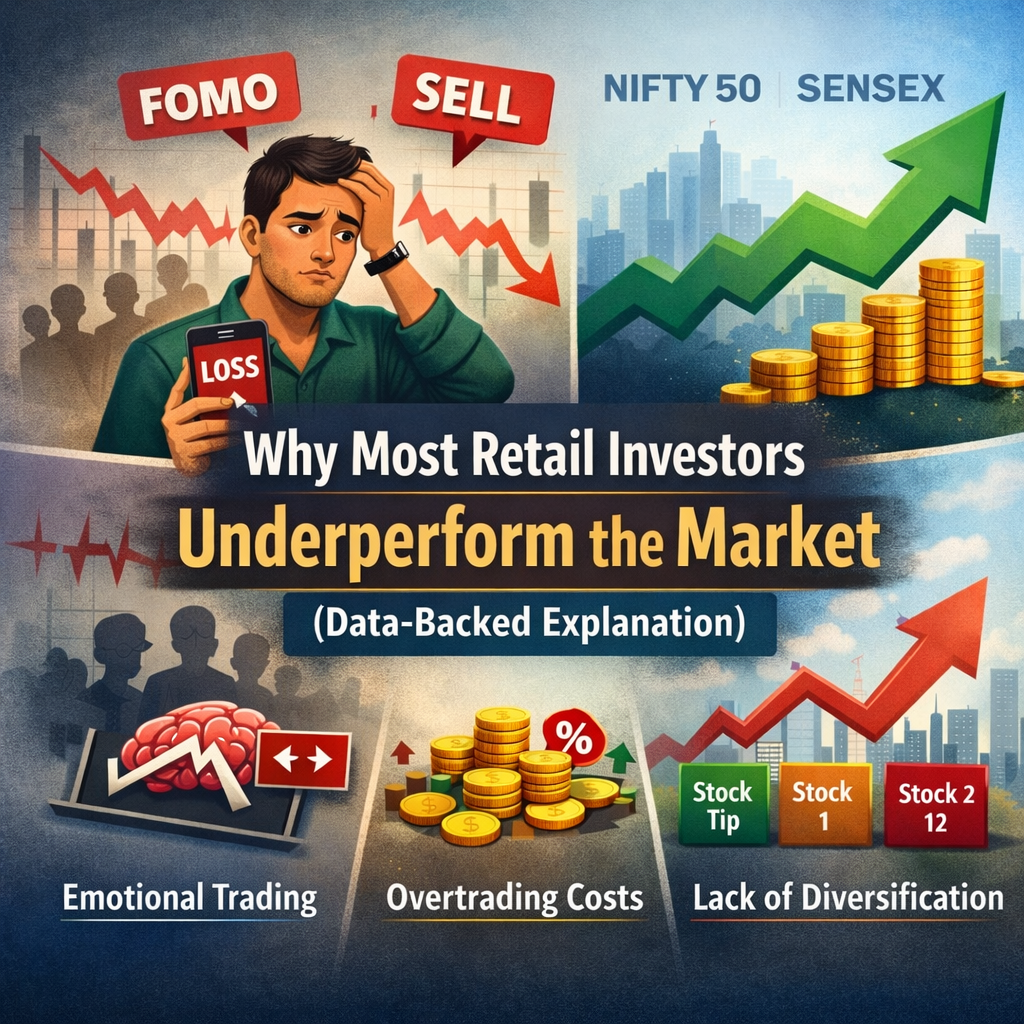
Many retail investors enter the stock market with one goal: to beat it. Yet, year after year, data shows that most individual investors fail to match, let alone outperform, broad market indices like the NIFTY 50 or the SENSEX. If the NIFTY 50 delivers an average annual return of 12%, but the typical investor earns only 7–8%, that gap represents underperformance.
Why does this happen? Is it lack of intelligence? Lack of information?
Surprisingly, the answer lies more in human psychology than in financial knowledge.
Table of Contents
What Does “Underperforming the Market” Mean?
When we say investors underperform, we compare their returns to a benchmark index.
A market index:
- Is diversified
- Follows a rules-based structure
- Has no emotions
- Does not react to daily news
An individual investor, however, makes active decisions — when to buy, when to sell, how much to allocate, and which stocks to choose. Those decisions often reduce overall returns.
The Data: Evidence of the Behaviour Gap
A well-known long-term study by Dalbar consistently shows that the average equity investor earns significantly lower returns than the market index over long periods. This difference between “market return” and “investor return” is often called the behaviour gap. The key reason? Poor timing decisions driven by emotions.
The Core Problem Is Not Knowledge — It Is Behaviour
Emotional Buying and Selling
Retail investors often:
- Buy when markets are rising (fear of missing out)
- Sell during crashes (fear of losing more money)
Consider the COVID-19 crash of 2020. Markets fell sharply, and many investors exited due to panic. Those who stayed invested benefited from the strong recovery that followed. Markets are volatile. Emotions amplify that volatility. An index does not panic. Investors do.
Overtrading Reduces Returns
Retail investors frequently trade more than necessary.
Each trade involves:
- Brokerage charges
- Securities Transaction Tax (STT)
- Slippage
- Capital gains tax
Even small costs, when repeated frequently, compound negatively over time. Data from Indian brokerage platforms like Zerodha has shown that a majority of active traders, especially in derivatives, end up losing money. More activity does not guarantee higher returns. In fact, excessive activity often guarantees lower returns.
Lack of Diversification
Broad indices such as NIFTY 50 hold shares of 50 large companies across sectors. This reduces company-specific risk.
In contrast, many retail investors:
- Concentrate money in a few stocks
- Invest heavily in trending sectors
- Act on tips or short-term news
Concentration increases risk. A single poor decision can significantly impact the portfolio. Diversification is boring — but it works.
Trying to Time the Market
Many investors attempt to:
- Predict market tops
- Wait for perfect entry points
- Exit before corrections
But consistently timing the market is extremely difficult. Research shows that missing just a few of the best-performing days in the market can drastically reduce long-term returns. Those strong recovery days often come immediately after sharp declines, when fear is highest. The market rewards time in the market, not timing the market.
Overconfidence Bias
Retail investors often believe they can consistently beat the market.
However:
- Even professional fund managers struggle to outperform benchmark indices over long periods.
- Many actively managed funds fail to beat their benchmark after accounting for fees.
If beating the index is difficult for professionals with research teams, data models, and full-time market access, it becomes even harder for individual investors making decisions part-time. Overconfidence leads to excessive risk-taking and frequent trading, both of which hurt returns.
What Can Retail Investors Learn?
The lesson is not that investing is pointless. The lesson is that behaviour determines outcomes.
Long-term data suggests that investors who:
- Stay invested
- Maintain diversification
- Avoid excessive trading
- Follow systematic investing strategies (like SIPs)
are far more likely to match or approach market returns.
Conclusion
Most retail investors do not underperform because the market is unfair.
They underperform because they fight the very principles that make markets rewarding over time — patience, discipline, and consistency.
The market does not panic.
The market does not chase trends.
The market does not react emotionally.
Investors often do.
In the end, most investors do not lose to the market.
They lose to themselves.