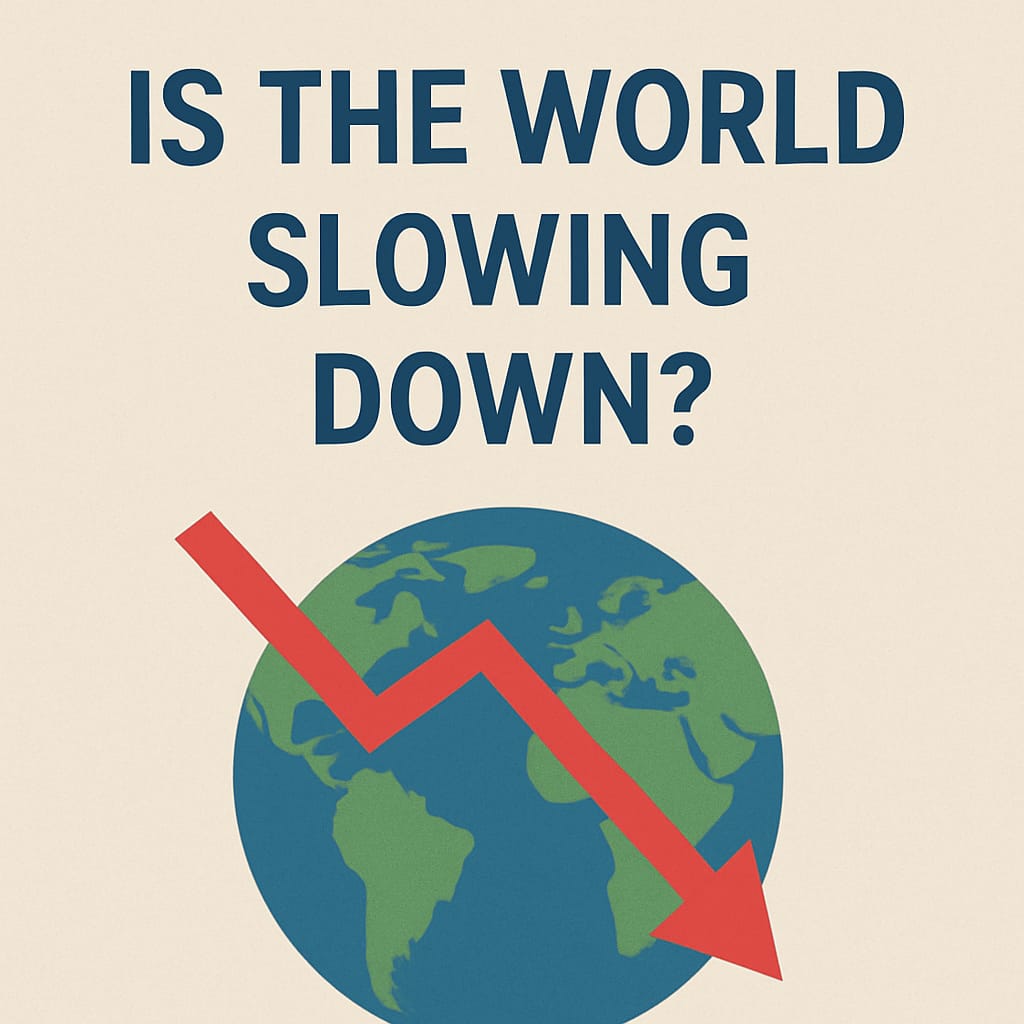
When news channels say “the global economy is slowing down”, it doesn’t mean the world has stopped growing. A “global economic slowdown” refers to a general deceleration in the rate of global economic growth (GDP). It does not necessarily mean a global recession (an outright contraction), but rather a period where economies expand at a slower pace than previously, often below their long-term potential. Let’s know more.
Table of Contents
What exactly is a global economic slowdown?
A global economic slowdown usually happens when:
- Businesses invest less
- Consumers spend cautiously
- Hiring slows
- Trade between countries weakens
Growth still exists but it’s just not fast or exciting. Think of it like this:
The car is still moving, but you’ve taken your foot off the accelerator.
Why is the world slowing down right now?
Some common reasons:
High interest rates: due to high interest rates, loans become expensive and spending reduces.
Inflation hangover: when people spend more on essentials and less on extras it is consciously a reason for economies slowing down.
Global tensions: wars, trade restrictions, uncertainty.
Debt pressure: due to debt pressures, governments and companies cut spending which makes economy slow down.
All this makes businesses and consumers play safe instead of taking risks.
Is slowdown the same as recession?
No, and this is where people get confused.
Slowdown | Growth is slower |
Recession | Economy actually shrinks |
Depression | Long, severe recession |
Most headlines today talk about slowdown, not recession.
Who feels the impact first?
Young job seekers: young job seekers suffer from fewer new opportunities.
Startups: funding becomes tight, demotivating fresh startups.
Export businesses: due to economy slowing down, global demand weakens.
Stock markets: more volatility, less optimism. People prefer safe and not risk during this time.
Most headlines today talk about slowdown, not recession.
Why does the news sound scarier than reality?
Expectations move faster than real life.
Markets react to future fears, while people feel effects slowly over time. That’s why headlines panic first and wallets react later.
📌Author’s Note:
This blog is not just research — it’s a step in my journey toward working with global institutions like the IMF and World Bank.
Stay tuned and grow with me