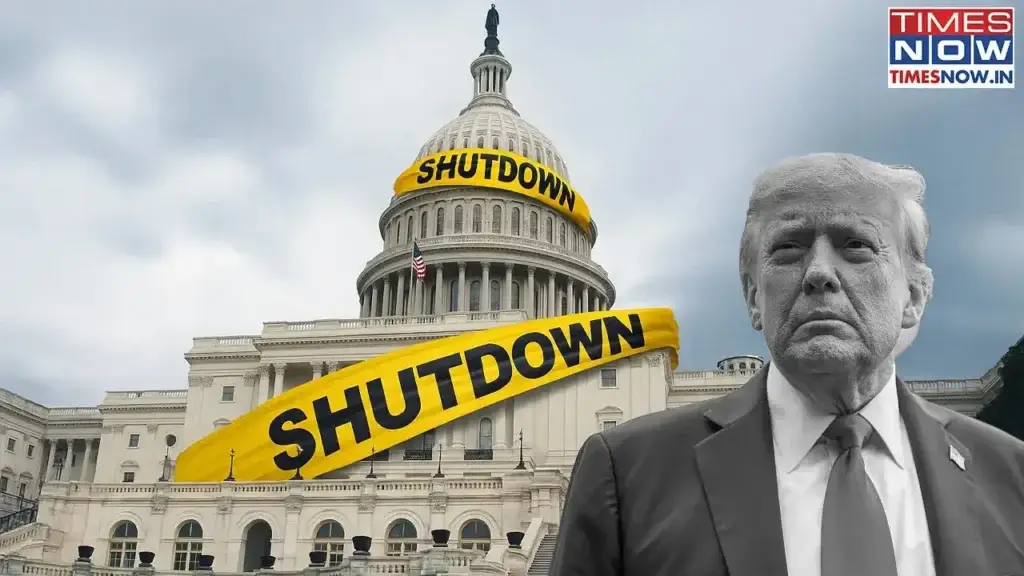
Oct 1, is considered as the starting of a fiscal year but have you heard about the US Government Shutdown on 1st of oct? A day that should mark fresh budgets and new plans often ends up in political drama, funding fights, and a shutdown that freezes parts of the world’s biggest economy. Let’s know more.
Table of Contents
What IS A GOVERNMENT SHUTDOWN?
In simple words, a government shutdown occurs when the legislative branch does not pass key bills which fund or authorize the operations of the executive branch, resulting in the cessation of some or all operations of a government, which ends up reducing public trust in politics. Since Oct 1 marks the new fiscal year, the government needs approval to spend money.
WHY IT HAPPENED IN “US”?
A US government shutdown happens when Congress fails to pass funding bills or a budget on time. If Democrats and Republicans can’t agree on how much to spend and on what, the funding lapses. Without that legal approval, many “non-essential” services stop, federal workers go unpaid, and the country enters a shutdown until a deal is made. Here, Republicans pushed a continuing resolution (CR) to keep spending at current levels until November, but Democrats refused to support that without restoring healthcare subsidies and Medicaid protections that were being cut.
Thus, because neither side agreed, funding lapsed — triggering the shutdown.
CURRENT “US” SITUATION
Many federal workers are furloughed (put on temporary leave, unpaid) or asked to work without pay if their role is deemed “essential”.
Essential services like national security, law enforcement, air traffic control, still operate but with reduced capacity.
Non-essential services and programs are paused, such as issuing new business loans, certain housing programs, research projects, and some public health or regulatory activities.
Delays in services like passport & visa processing, small business loan approvals, and other government customer services tend to slow down.
Mandatory programs like Social Security and Medicare usually continue, because they are funded by permanent appropriations that don’t require yearly approval.
Economic damage: lost productivity, reduced consumer confidence and spending, and a drop (of about $15 Billion) in GDP for each week the shutdown continues.
Back pay: Typically, once the shutdown ends and funding is restored, furloughed federal employees are paid retroactively for missed day.
WHAT’s NEXT?
- Congressional Negotiations & Deals
Lawmakers will huddle behind the scenes. They may try to pass a short-term funding bill (continuing resolution or “CR”) to reopen parts of the government temporarily, while longer budget deals are worked out.
- Political Pressure Builds
As the shutdown drags on, public frustration with politicians rises. Both parties will be under pressure to appear “solutions-oriented” to avoid blame. - Essential Services Strained
Some critical agencies for e.g. nuclear security, military, judiciary etc. have limited reserves. If the shutdown lasts, even these “excepted” operations could be affected. - Economic & Social Impacts Deepen
Local economies that rely on federal activities such as government contracts, federal employee spending etc. will feel stress. Consumer confidence could weaken, markets may get jittery. - Back Pay & Recovery
Once funding is restored, furloughed workers typically get retroactive pay for the days missed. But getting full operations back to normal takes time. - Aftermath & Reform Talk
After the shutdown ends, there’ll likely be debates over how to reform the budget process to prevent future standoffs. Some may propose rules to penalize lawmakers or require automatic funding.
CONCLUSION
The US government shutdown is less about running out of money and more about political deadlock. Until lawmakers strike a deal, ordinary citizens and the economy bear the brunt. The coming days will show whether this is a brief pause or another prolonged standoff in America’s fiscal battles.
📌Author’s Note:
This blog is not just research — it’s a step in my journey toward working with global institutions like the IMF and World Bank.
Stay tuned and grow with me