INTRODUCTION
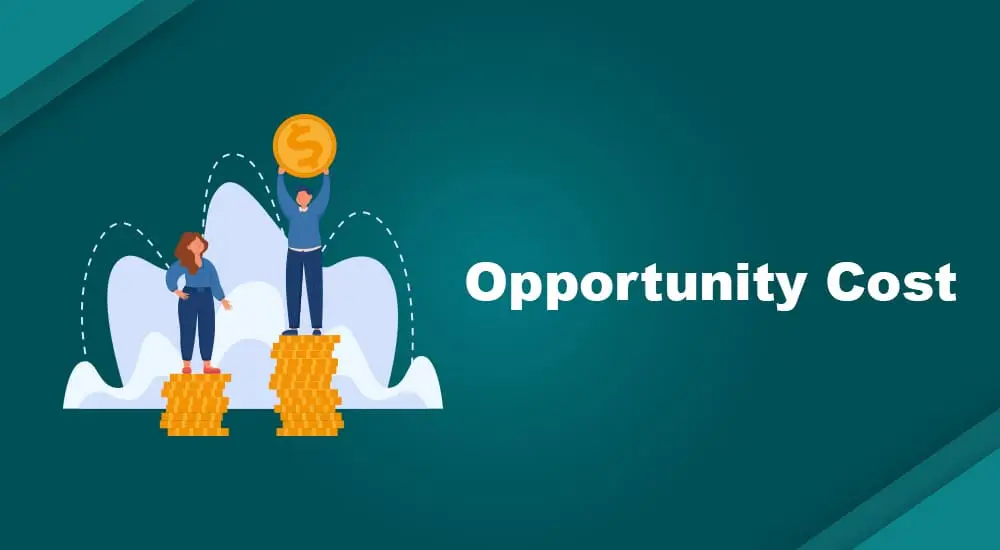
Opportunity Cost is what you sacrifice while choosing one option over another, it is the value of the best alternative that is given up when making a choice.
For example, a student has $20, he can either spend those $20 watching a movie or buying books. If he chose to spend them on the movie, the opportunity cost would be the benefits he might have gained if he chose books and vice versa.
Now the question may arrive that why does opportunity cost matters in economics and daily life? – Basically, opportunity cost represents the value of the next best alternative that is not chosen. Opportunity costs are a central concept in economics, as they help to understand and weigh up the true costs of decisions.
Table of Contents
BASIC ECONOMIC PROBLEM – SCARCITY AND CHOICE
What is Scarcity? Scarcity means ‘limited’ resources. We do not have unlimited money, time natural resources (like water, land, oil), human resources (like skilled labor) but what we do have is – unlimited wants, people want better food, clothing, education, cars etc.
Scarcity = Limited resources + Unlimited wants
What is Choice? Because of limited resources, we are bound to make choices and choose:
- What to produce?
- How to produce?
- For whom to produce?
This leads to the need for decision–making — by individuals, businesses, and governments.
But, how Scarcity and Choice Lead to Opportunity Cost?
When we make a choice due to scarcity, we have to give up the next best alternative — this is called opportunity cost.
Opportunity Cost = The benefit you miss out on when choosing one thing over another.
Example to Understand All Three
Imagine you have ₹500 and two options:
- Buy new clothes
- Watch a movie in the theatre
You choose to buy new clothes.
- Scarcity: You have limited money (₹500).
- Choice: You chose to buy new clothes.
- Opportunity Cost: The joy you missed from not watching a movie.
In Economics, scarcity forces choices and Choices always involve opportunity costs. Every economic decision is about what you’re gaining vs. what you’re giving up. Hence, scarcity creates the need to choose, and every choice has an opportunity cost — the value of the next best alternative you give up.
OPPORTUNITY COST vs MONETARY COST
Opportunity cost refers to the potential benefits missed when choosing one option over another, while monetary cost represents the actual amount of money spent on that option.
Monetary Cost:
Definition: The actual amount of money spent on a good, service, or investment. Example: If you buy a $100 movie ticket, the monetary cost is $100.
Opportunity Cost:
Definition: The value of the next best alternative that is forgone when making a choice. Example: A farmer chooses to plant wheat; the opportunity cost is planting a different crop.
FORMULA:
Opportunity Cost = Return of the Best Foregone Option – Return of the Chosen Option
Explanation:
Return of the Best Foregone Option: This refers to the potential benefit or return that would have been earned if the most promising alternative had been chosen.
Return of the Chosen Option: This is the actual benefit or return obtained from the option that was selected.
TYPES OF OPPORTUNITY COST
Opportunity costs are broadly categorized into two types: Explicit and Implicit.
Explicit opportunity costs are the monetary costs of a decision, while implicit costs are the non-monetary costs, such as the value of time or resources used for an alternative purpose.
REAL – LIFE EXAMPLES
- Individual Level:
Choosing between a job and higher education.
- Suppose a student decides to pursue a master’s degree instead of taking a ₹30,000/month job offer.
- Opportunity Cost: The ₹30,000 monthly salary (plus work experience) they are giving up while studying.
- Business Level
A factory using its space to make Product A instead of Product B.
- A company has limited machine hours. It chooses to produce smartphones instead of tablets.
- Opportunity Cost: The profit it could have earned from selling tablets.
- Government Level
Spending on defense vs. education.
- The government allocates ₹10,000 crore to defense instead of improving schools and training teachers.
- Opportunity Cost: The long-term benefits of a better-educated workforce.
Sunk Cost vs Opportunity Cost
Sunk cost refers to the past cost that cannot be recovered while opportunity cost is the future benefit lost by not choosing the next best alternative. Sunk cost is ignored in decision-making while opportunity cost is considered in decision-making.
Example: You bought a ₹500 movie ticket but the movie is boring. Sunk Cost Fallacy: “I paid, so I must watch it.”, Rational Decision (Opportunity Cost): Leave and use that time better (study, relax, etc.).
Opportunity Cost in Economic Theories
Production Possibility Frontier (PPF):
It shows the maximum output combinations of two goods with limited resources. Opportunity Cost is represented by the slope of the PPF. For example: A country can produce either 10 tanks or 1,000 textbooks. If it chooses 1 more tank, it must give up, say, 100 textbooks — that’s the opportunity cost.
Comparative Advantage (International Trade)
Even if a country is more efficient in producing everything, it should specialize in what it produces at a lower opportunity cost. For example: India can produce 1 unit of textile or 2 units of wheat and USA can produce 1 unit of textile or 4 units of wheat. India has a lower opportunity cost for textile, and USA for wheat. So, India should export textiles and import wheat — maximizing global efficiency.
MY POV / CONCLUSION
Opportunity cost is more than just an economic concept — it’s a mindset that shapes our everyday decisions. From individuals managing time and energy, to businesses allocating resources, and governments setting national priorities, understanding what we give up helps us make better, more rational choices.
By recognizing both monetary and non-monetary opportunity costs, we learn to prioritize what truly matters. In a world of limited resources and unlimited wants, smart decision-making begins with asking one simple question:
“What am I giving up by choosing this?”
Mastering this way of thinking isn’t just useful — it’s essential for personal growth, productivity, and economic understanding.
📌Author’s Note:
This blog is not just research — it’s a step in my journey toward working with global institutions like the IMF and World Bank.
Stay tuned and grow with me!